

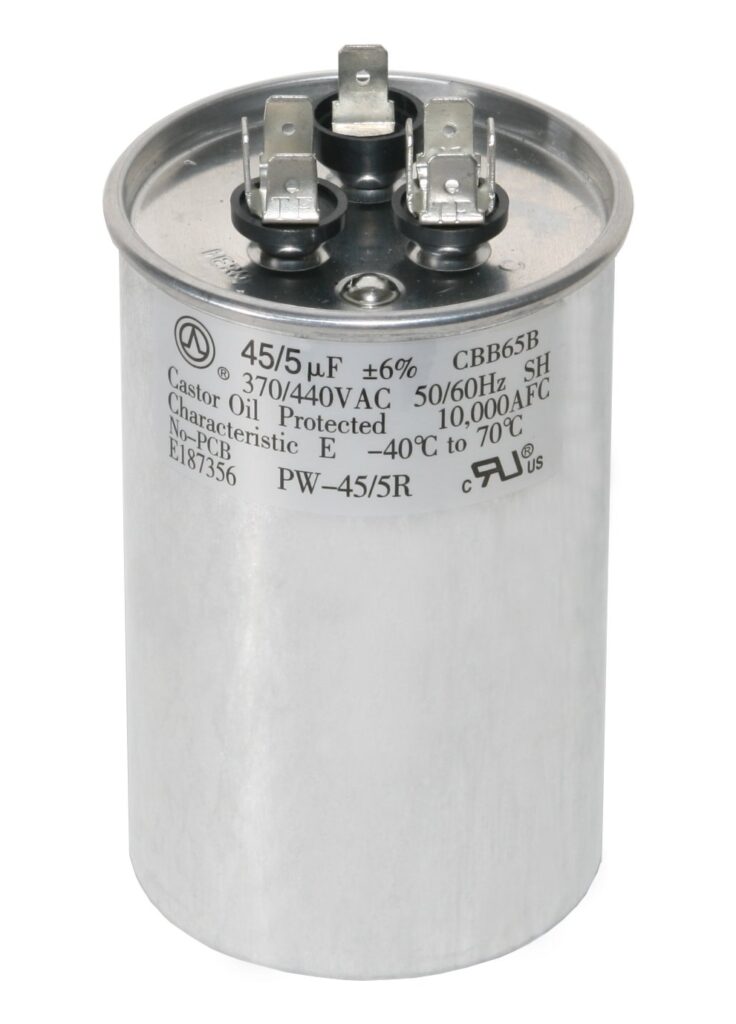
Whether you\’re troubleshooting a no-cool call or replacing a dual capacitor on a rooftop unit, understanding how capacitors work — and why quality matters — is essential for every HVAC technician. These small components play a major role in system performance, reliability, and lifespan.
🔌 What Is a Capacitor in an HVAC System?
Capacitors store and discharge electrical energy to help motors start and run. In HVAC equipment, you’ll typically find them in:
- Compressors (hermetic and scroll)
- Condenser fan motors
- Indoor blower motors
There are two main types used in HVAC applications:
- Start Capacitor – Delivers a high-torque jolt to start the motor
- Run Capacitor – Maintains a steady voltage supply during operation
Many residential and light commercial units use dual run capacitors to serve both the compressor and condenser fan with a single component.
🛠 Common Capacitor Failure Issues
As a tech, you’ve probably seen one (or all) of these in the field:
- Swollen or bulging cans
- Leaking oil or ruptured cases
- Microfarad ratings drifting beyond ±6% tolerance
- No start or intermittent start for fan or compressor
- Blown fuse or tripped breaker due to shorted capacitor
Capacitor failure is often seasonal — especially in summer, when start loads are heavier and components are under thermal stress.
⚠️ Why Proper Sizing and Rating Matter
Using the wrong µF rating, voltage rating, or non-CSA-certified product can lead to:
- Motor overheating and premature failure
- System inefficiency or overamping
- Failed inspections on commercial jobs
- Voided manufacturer warranties
Always match the microfarad (μF) rating and voltage (usually 370V or 440V). If you\’re unsure, always size up the voltage rating — never down.
🔧 Pro Tips for Technicians
- Keep a digital capacitor tester (not just a multimeter) in your kit
- Stock a universal dual-run capacitor for emergency calls, but replace with the exact rating ASAP
- Mark your caps with install date and microfarad tolerance — especially for commercial PMs
- Consider replacing the cap during compressor swaps to avoid callbacks